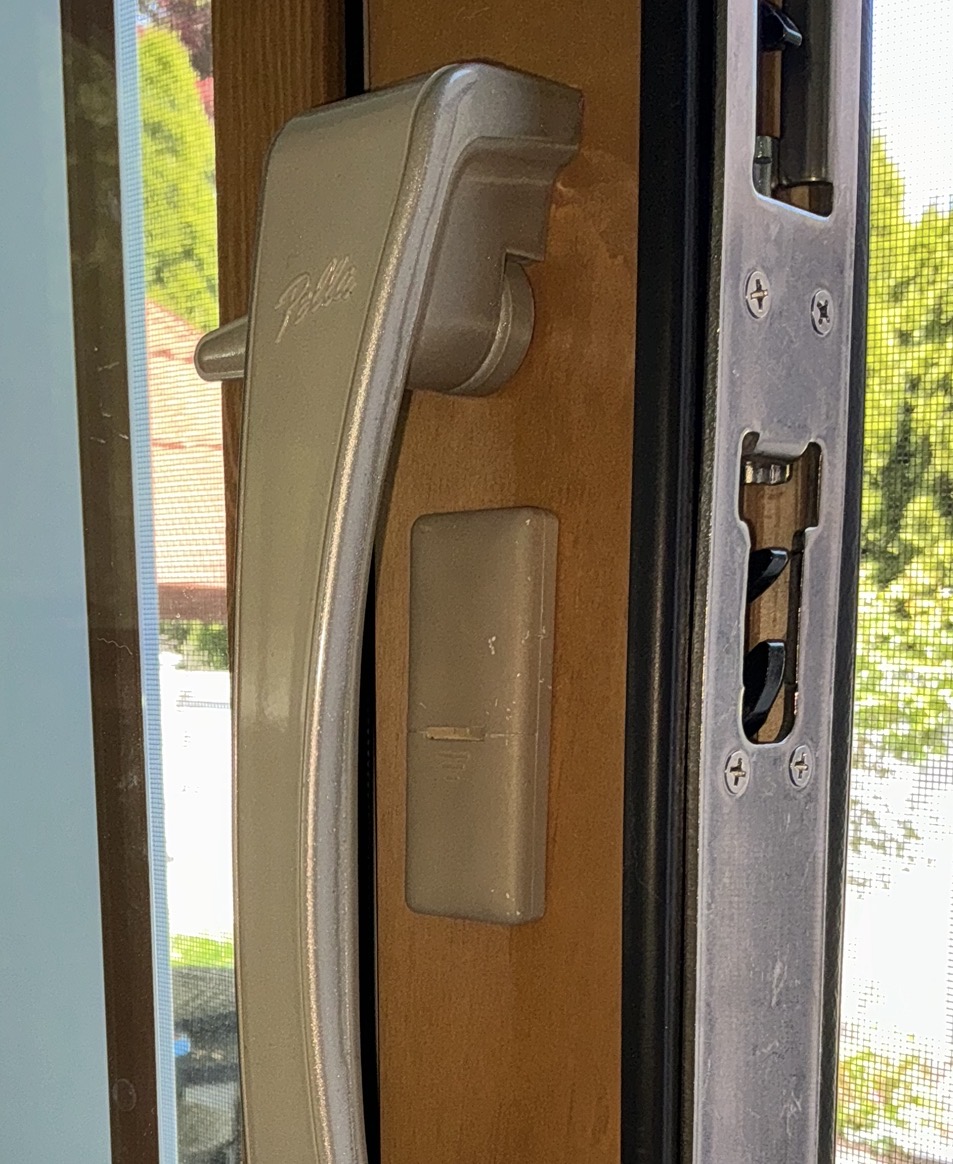
Our old sliding patio door wore out after 25 years of service. So we replaced it with a beautiful Pella sliding door. Didn’t know when we bought it that it only locks if it is closed! That’s an awesome feature in and of itself; you cannot erroneously lock yourself out.
But there’s more. First is that a flat-ish contact sensor such as the Visonic can sit entirely within the frame. So it is completely hidden. Great for aesthetics.
Secondly - and the point of this post - is that the mechanism leaves room for ‘addition’. In this case, I bent up a steel rod such that when the door is unlocked, the rod drops approximately a quarter inch. So I can position a magnet atop the rod, and when the magnet rises slightly it closes the contact sensor!
So now Smartthings can know that both front and patio door are closed and locked.
I would insert an image if I could figure out how.
Here is the image. I’ve drawn blue lines to show where the metal rod continues behind the plate. This image is just a prototype to prove the concept. There are bits of “magnet-susceptible” metal in the mechanism itself that make the metal rod not drop correctly when the magnet is in place. I will possibly purchase aluminum rod to remake it, or simply put a plastic spacer (perhaps a shaped “magnet carrier”) in between the magnet and the steel rod. And then a more visually appealing plastic cover.
This is better than a “handle for sliding doors”. In shopping for the new door, I saw that not only are there differences from manufacturer to manufacturer - there are also differences in a single manufacturer. Pella currently has three different mechanisms of which I am aware, all of them different than the one in the door I just replaced.
There would have to be serious custom work to get a generic smart handle to work correctly with a given door. That work would be nearly impossible to hide. With my work here, the custom components are completely hidden and are perfectly suited to the internals of the mechanism.
My only issue now is that it works “in reverse”. That is, when the sensor is closed the door is unlocked and vice versa. The final edition will have the thing working in the correct order (it’s just a matter of positioning).
Oy. It works. But ultimately, it is not a fully reliable indicator of whether the door lock is fully locked. The door can be closed without being locked, and it sometimes shows as locked.
Ultimately, the only real solution is in the nitty gritty of the locking mechanism. Either a rotating part in the interior of the lock itself, or a sensor in the handle.
I know what would need to happen in the interior, but am highly reluctant to do that. It would require some complexity to ‘export’ the movement to the door frame, and messing with door mechanisms does not excite me.
What could work very well is a custom hardwood handle. I have some cherry in the garage that’s very tough and a bit knotty and curvy, and therefore might be ideal. The existing ‘thumbturn’ has space within that can fit a neodymium magnet. So when it rotates into ‘locked’ position, that magnet could sit directly above a sensor. I have an Iris sensor that might work for the purpose.
Will have to explore a bit more. I did look for a handle with built-in zigbee sensor, but cannot find one.
My Visonic contact sensor would actually fit under there. The issue I see is people whacking it with their hand while operating the thumbturn or merely grabbing the handle.
I would also need double sided tape that is ultra thin. But it’s worth a try!
Double sided tape is likely to dry out over time. You might try a very thin piece of poster putty (sticky tack). I used this for some applications that are now over 8 years old and still holding strong.